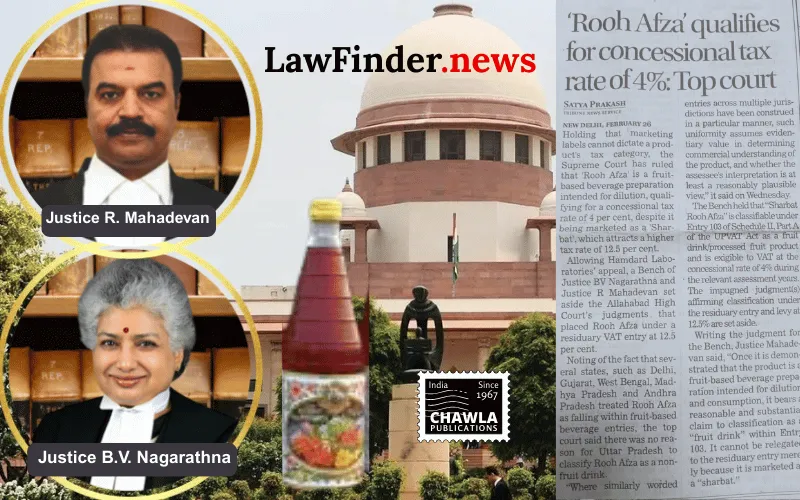
The Apex Court overturns the High Court's decision, classifying "Sharbat Rooh Afza" under the concessional VAT rate of 4% as a fruit drink.
In a landmark judgment, the Supreme Court of India has ruled in favor of M/s Hamdard (Wakf) Laboratories, classifying its popular product "Sharbat Rooh Afza" as a fruit drink under Entry 103 of the Uttar Pradesh Value Added Tax Act, 2008. This decision overturns the previous ruling by the High Court of Judicature at Allahabad, which had classified the product under a residuary entry, subjecting it to a higher VAT rate of 12.5%.
The case, adjudicated by Justices B.V. Nagarathna and R. Mahadevan, revolved around the classification of "Sharbat Rooh Afza," a non-alcoholic sweetened beverage containing fruit juices, vegetable extracts, and added flavors. The primary contention was whether the product should be classified as a fruit drink eligible for a concessional VAT rate of 4% or as an unclassified item under the residuary entry with a tax rate of 12.5%.
The Supreme Court's judgment emphasized the application of the common parlance and essential character tests in determining the classification of goods under taxation laws. It held that "Sharbat Rooh Afza," containing declared fruit juice and deriving its essential beverage identity from fruit-based constituents, merits classification as a fruit drink under Entry 103. The Court noted that the expression "fruit drink" is illustrative and inclusive, not prescribing any quantitative threshold of fruit content.
The Court also clarified that regulatory definitions under food safety laws are not determinative for fiscal classifications unless expressly incorporated into taxing statutes. It stated that the burden of proof to classify goods under a residuary entry lies upon the Revenue, and resort to such a clause is permissible only when goods cannot reasonably fit within a specific entry.
This judgment has significant implications for the taxation of similar products, as it sets a precedent for interpreting fiscal statutes in line with commercial understanding. It also reinforces the principle that in cases of ambiguity, the interpretation favoring the assessee must prevail.
The Supreme Court directed the respondent authorities to grant consequential relief to M/s Hamdard (Wakf) Laboratories, including refund or adjustment of excess tax paid. This decision is expected to impact similar cases across various jurisdictions, providing clarity on the classification of products under VAT statutes.
Bottom Line:
Classification of goods under taxation laws must follow the common parlance and essential character tests, and regulatory definitions cannot override fiscal interpretations unless expressly incorporated into the taxing statute.
Statutory provision(s): Uttar Pradesh Value Added Tax Act, 2008, Entry 103, Schedule II Part A, Schedule V, Common Paralance Test, Essential Character Test.